


Ingredients for the Hauberlinge
for approx. 40 pieces
- 250 ml Unertl wheat beer
- 325 ml water (lukewarm) → of which 100 ml for the pre-dough
- 300 g egg white
- 750 g wheat flour type 405
- 250 g rye flour type 610
- approx. 40 g salt
- 1 1/2 block of yeast
- approx. 30 g tablespoon caraway seeds
- Clarified butter (for frying)
Preparation of the Hauberlinge
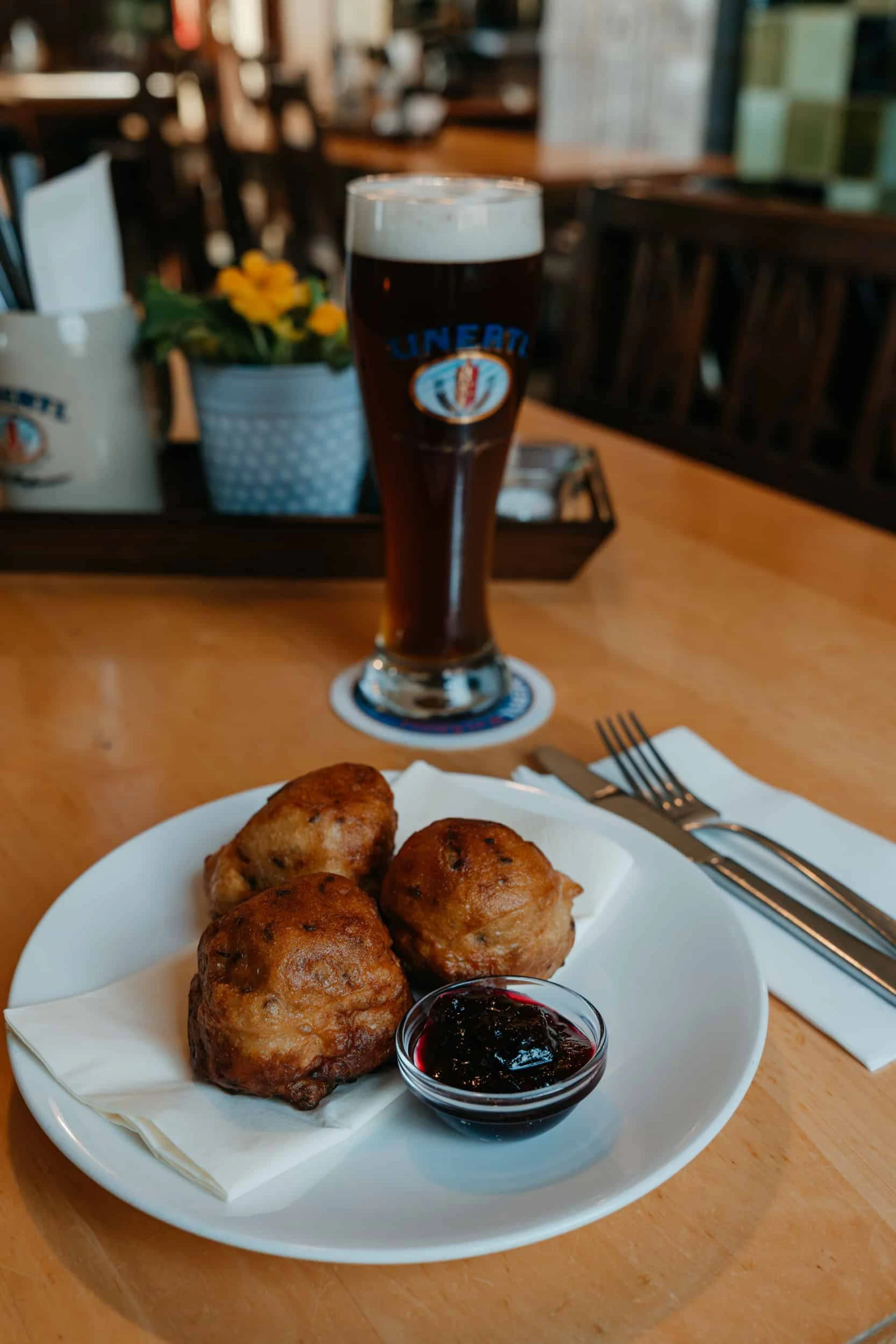
First mix 1/4 of the wheat flour and 1/4 of the rye flour with salt and make a small well in the centre. Pour the yeast into the well and stir in about 100ml lukewarm water to make a starter dough. Leave this to rest in a warm place until it has risen properly. Add the remaining ingredients, then mix everything well with a spoon and knead the dough vigorously for approx. 5 minutes using a hand mixer with a dough hook attachment to achieve a smooth, elastic consistency. Then leave the dough to rest in a warm place until it has roughly doubled in size - this takes about 45 minutes (the rising time may vary).
To make the Hauberlinge, slowly heat the clarified butter in a suitable pan over a medium heat. As soon as the dough has risen well and the fat has reached the right temperature, use a tablespoon to scoop out small portions of the dough and carefully place them in the hot lard. (Tip: it's easier with a wet spoon)
Cover and fry for approx. 5 minutes until they are golden brown on the underside. It is advisable to wrap the lid of the pan with a tea towel to prevent condensation from forming. After the first browning, carefully spray the hauberlings with lard and turn them over until they are golden brown and crispy all over.
Recipe from Bräustüberl Unertl in Haag i. OB
History of the Hauberlinge
Hauberlinge are a medieval lard pastry from the Inn-Salzach region with a special history: back then, people were not allowed to eat meat or animal products such as eggs or butter during Lent. Cooking with lard was also not permitted.
However, Count Sigismund von Haag (Haag in Upper Bavaria) did not want to do without it and wrote to the Pope in Rome. He asked him to allow his subjects to use lard made from butter in the kitchen during Lent. He argued that the olive oil used in Italy was too expensive in Bavaria and that his subjects objected to the flavour. He also complained that his subjects were becoming ill and weak due to the plant-based fasting foods.
As a result, Pope Innocent VIII actually granted this permission in 1485, so that the poor people of the county of Haag were allowed to bake Küchl with lard from then on - these were henceforth called Hauberlinge or Haubenküchl. Historians jokingly refer to this permission as the "Hauberlingdispens". It was not until 1491 that this licence was granted to all Christians in Germany (R. Münch: Das große Buch der Grafschaft Haag).
The name "Haubenküchl" is explained as follows: The Hauberlings are repeatedly turned in the pan with lard so that they are nicely browned at the top and bottom and have a brown "cap", while they should remain rather pale in the centre. They are traditionally eaten with venison ragout, but also as a side dish with many other dishes.
